



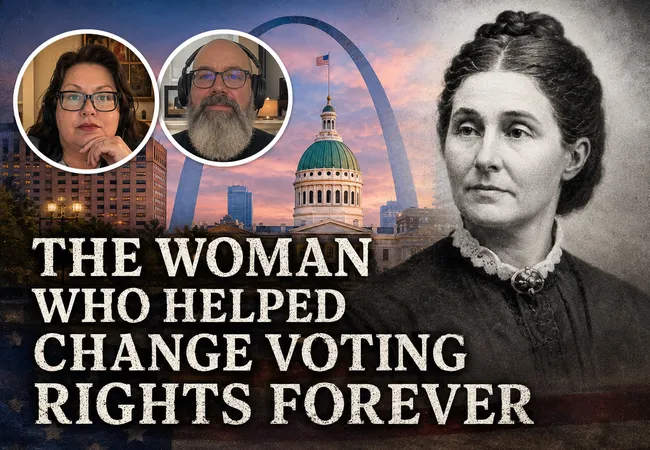
The Woman Who Helped Change Voting Rights Forever

[00:00:00] Jess Conaway: Welcome to another edition of Shaka Guide Stories we love. I am Jess Conaway, writer and narrator. And with me today is Rayne Warne, our managing editor, Rayne. Say hi to the people.
[00:00:16] Rayne: Hey People.
[00:00:17] Jess Conaway: So we are gonna talk today about first of all it's, it's Women's History Month. So Happy Women's History Month, and we're gonna talk about women's suffrage. But very clearly you're not a woman. But on behalf of all women, we thank you for being an ally, but why don't you tell us why we're gonna tell this particular story today?
[00:00:32] Rayne: We're telling this story, as you said, Because it's Women's History Month. And two, because the character we're talking about today, or not character, but actual historical person we're talking about today is a bit of a overlooked hero of the women's suffrage movement. I certainly hadn't heard about her before writing this tour.
[00:00:52] But since discovered her story, it was a no-brainer to include it and share it with more people.
[00:00:57] Jess Conaway: This is a story coming out of the Gateway Arch National Park Tour, and you are the authority on Gateway Arch National Park, so...
[00:01:04] Rayne: I am. Yeah. For Shaka Guide.
[00:01:06] Jess Conaway: Yes, you wrote that tour. Did you narrate that tour? No.
[00:01:11] Rayne: I didn't. No, no.
[00:01:14] Jess Conaway: Coming soon, Rayne will be narrating tours, so that's exciting.
[00:01:17] What does Gateway Arch have to do with women's suffrage?
[00:01:20] So, Rayne. What does Gateway Arch National Park, or Gateway Arch itself have to do with women's suffrage?
[00:01:29] Rayne: That's a great question. Well, for those who don't know, some context, Gateway Arch National Park is located in the downtown St. Louis, Missouri. It's a relatively new national park at less than 10 years old, as least with National Park status. It's also by far the smallest national park. But what it has to do specifically with women's suffrage is that on the grounds of the National Park sits the Old Courthouse of St. Louis. And inside that courthouse was the beginning of a landmark legal case in the fight for women's right to vote. Legal case brought by Virginia Minor.
[00:02:05] Jess Conaway: You're answering my question before I even ask it. Go ahead. Tell us about Virginia Minor.
[00:02:11] Rayne: Virginia Minor Virginia Minor is an often overlooked hero of the women's suffrage movement. We all know names like Elizabeth Katy Stanton or Susan B. Anthony, but Virginia Minor also played a really important early role in women's suffrage movement, and I had certainly never heard about her before I started researching and writing this tour. But once I came across her story it was a no-brainer. I had to include it and share the story with more people. The main story that we're gonna talk about today that concerns the legal case at the old courthouse picks up in the year 1872 during a presidential election, and Virginia decided that she wanted to vote.
[00:02:51] Jess Conaway: Okay, so she tries to vote. Who was, who was running in the election, do you know?
[00:02:58] Rayne: Yeah, so 1872, that would've been Ulysses S. Grant running as the incumbent running for a second term against Horace Greeley. Now, we don't know who she wanted to vote for. Very likely she probably was gonna vote for Grant. I know that I think it was the same year where Susan B. Anthony cast her illegal ballot in New York for Grant.
[00:03:19] It's also possible, though, Because 1872, if I remember right, was the first year that a woman ran for president Victoria Woodhall, I believe her name was. So it's possible Virginia wanted to cast a vote for her, but we, we honestly don't know.
[00:03:35] Jess Conaway: We should include that on another tour. That would be really interesting.
[00:03:38] Rayne: It would be very interesting.
[00:03:40] Jess Conaway: Horace Greeley is the 'Go West' young man guy, as I recall.
[00:03:44] Rayne: Oh, that's right. I'd forgotten that.
[00:03:46] Jess Conaway: Definitely talk about him in our Utah tours.
[00:03:49] Okay. So can you kind of paint us a picture about what was going on at that time?
[00:03:55] Like why, why was she so emboldened to go in to vote? What kind of, what was the temperature at the time there like, in that time in history?
[00:04:06] Rayne: Absolutely. So, Virginia figured that she would go down there to the registrar's office and register to vote because she honestly believed that she had the right to. Her and her husband, Francis, at the time had a political theory known as the New Departure. They believed that based on the 14th amendment, that women already had the right to vote.
[00:04:27] The 14th Amendment is what grants citizenship to people who are either born or naturalized here, and it also promises equal protection under the law. Virginia argued that the right to vote was a fundamental privilege of national citizenship, and therefore, with equal protection, she should be able to vote just like men.
[00:04:48] This was a time when women had very few rights, especially married women, and that's owing mostly to the doctrine of something called coverture. So married women lacked any legal stance apart from their husbands. They couldn't own property without their husband's consent. They couldn't serve on juries. They couldn't hold public office. They had little access to higher education or even prevented from holding certain jobs like lawyer. Married women also didn't have legal rights over their own children.
[00:05:19] Jess Conaway: Wait, what? They didn't have rights over their own children. That's insane.
[00:05:23] Rayne: No, they did not. It was all over to their husband. So basically, if a woman was married, her legal existence was suspended and everything was placed under her husband's control.
[00:05:34] Jess Conaway: Huh? Oh my gosh. I mean, you, you read about it, you know about it, but like, then you hear stuff like that, it's insane.
[00:05:41] Rayne: It's wild, right?
[00:05:44] Jess Conaway: So Virginia didn't just decide, you know, 'Hey, you know what? This is the election I'm gonna vote.' Can you tell us a little bit about her early life?
[00:05:51] How, how did she kind of come to this understanding that she was going to be a trailblazer without trying to be a trailblazer? Like, what was she like?
[00:06:01] Rayne: Sure. So Virginia was born in 1824. She lived there in St. Louis and she had actually dedicated her life to women's rights. I believe it probably started at least significantly during the Civil War when she served in the Ladies Union Aid Society. Then in 1867, she actually co-founded and became the first president of the Women Suffrage Association of Missouri.
[00:06:23] It was the first organization in the world that was solely dedicated to enfranchising women. So, giving women the right to vote. That same year that she founded that organization, she petitioned the Missouri State Legislature to remove the word male from the state constitution.
[00:06:40] Again, trying to make it equal so that she could vote. So, as you can see, she had spent years and really dedicated her life to being a pioneer in the women's suffrage movement.
[00:06:50] Jess Conaway: That's crazy and it's crazy that we haven't like, heard about her. So, just real quick, can you, can you kind of explain the women's suffrage movement for those that may not fully understand that.
[00:07:05] Rayne: The women's suffrage movement was chiefly about giving women the right to vote, about enfranchising women. This was a time when, you know, women were still required to pay taxes, but they didn't have a vote, they didn't have a say in who was governing their states and governing their country.
[00:07:20] So it was a form of taxation with that representation.
[00:07:23] Jess Conaway: Yeah.
[00:07:23] Rayne: This was obviously and blatantly unfair and so this was women banding together to try to change that.
[00:07:29] Jess Conaway: Okay, let's go back to the moment. The big moment. She goes to the courthouse to register to vote. She's very excited. What happens at the courthouse?
[00:07:40] Rayne: Wasn't quite at the courthouse yet at this time. She was heading down to the registrar's office, and the registrar was a man named Reese Happersett. So she goes there to register to vote. And Happersett flatly says no. He refuses to register her. It was at that time in the state constitution illegal for women to vote.
[00:07:59] He, according to his mind, was following the law.
[00:08:02] Jess Conaway: So Haber refuses, but it does not deter her. Right? So how does she kind of decide to bring the lawsuit? Like, was her husband on board? What was he like?
[00:08:14] Rayne: So no, she is not deterred by any of this. She probably honestly expected it. Soon after she was denied the being able to register to vote. She get her husband Francis filed a lawsuit against Mr. Happersett.
[00:08:28] Jess Conaway: Which was convenient, right? Because her husband was a lawyer.
[00:08:31] Rayne: Her husband was indeed a lawyer.
[00:08:34] Jess Conaway: So that's great. So she knew a little bit about the law, but he was supportive. Yeah. Like
[00:08:39] Rayne: He was, yeah.
[00:08:40] Francis was immensely supportive. He was very progressive for his time. He was actually considered by other people to be a women's rights man, and he practiced gender equality in his own marriage to Virginia. He is the one who personally drafted the resolutions that formed the foundation of their New Departure strategy.
[00:08:58] And because Virginia as a woman could not sue under Missouri law, Francis is the one who acted as her co-plaintiff and her legal counsel.
[00:09:07] Jess Conaway: So what specifically did they put in that lawsuit?
[00:09:11] Rayne: Yeah. So they decided to sue Reese Happersett for $10,000 in damages for depriving Virginia of what she believed were her constitutional rights.
[00:09:19] Jess Conaway: Do we know what that is in today's money?
[00:09:22] Rayne: Oh, you know what? I don't, we'll have to look that up.
[00:09:25] Jess Conaway: I'm sure somebody can.
[00:09:26] Rayne: Yeah, 10,000 in the dollars in, in that day. That was an enormous sum of money and again, probably largely symbolic to bring more attention to the case.
[00:09:35] Jess Conaway: Yeah.
[00:09:35] Rayne: This case was essentially Virginia and Francis putting their New Departure theory to the test. They wanted to know if this would hold up in court.
[00:09:44] Jess Conaway: Okay. So it did it, what was the outcome there?
[00:09:49] Rayne: So this is where it kind of stops being a feel good story, if you can even call it that up to this point. So the Minors, they tried that case there in, I think it was Circuit Court No. 5 at the time in the courthouse, they lost the local case at the St. Louis circuit court level. They lost again at the Missouri Supreme Court.
[00:10:11] So they took their case all the way to the highest court in the land, the United States Supreme Court. And in 1875, 3 years after all of this started, the U.S. Supreme Court unanimously ruled against Virginia and Francis. So, they lost this at every stage.
[00:10:32] Jess Conaway: Do you think at some like they expected to lose? In all the research you've done with Virginia Minor, do you think they kind of expected it?
[00:10:40] Rayne: It's hard to say if they expected it. I mean, on one hand I do think they legitimately believed they had a strong legal argument in the 14th Amendment. I don't think they were surprised by the outcome considering just the temperature of, you know, what was going on at that time, and of course, in precedent.
[00:11:02] Jess Conaway: So they, I'm sure they had a lot of support though.
[00:11:05] Rayne: They had a lot of support. Yeah. The women suffrage movement wasn't necessarily unified at that time, but they had a lot of support from many areas and many people in, in the movement.
[00:11:15] Jess Conaway: So what happens after? I hope that she doesn't, she doesn't like lose faith in the system. Right? Does she keep fighting? Does he keep fighting?
[00:11:23] Rayne: They both continue to advocate for women's suffrage and women's rights in general. So despite all of these setbacks, despite three years in court and losing at the Supreme Court level they keep going. However, one of the fallouts of this is that essentially the entire women's suffrage movement abandons the New Departure Theory.
[00:11:43] It was defeated in court so they could no longer rely on this argument about the 14th Amendment. So instead, Virginia and the rest of the movement- they went after trying to change the constitution. Virginia herself went on to lead tax revolts, again, saying that women should protest taxation without representation.
[00:12:01] She campaigned right alongside Susan B. Anthony. In 1889, Virginia testified before Congress on the topic of women's suffrage, and in her will before she died, she even left Susan B. Anthony a thousand dollars specifically to carry on the fight for women's rights.
[00:12:19] Jess Conaway: That's awesome. She definitely did influence some, you know, a whole new group of, of women. Because on our D.C. tour, which is forthcoming, we talk about Alice Paul, who, kind of took up that mantle and, and ran with it in the early 1900s. Alice Paul. Alice Paul with-
[00:12:40] Rayne: Yeah, tell me more.
[00:12:42] Jess Conaway: Her suffragette friends, and her, and I don't have the dates in front of me, so I don't remember when.
[00:12:46] But the day before, Woodrow Wilson's inauguration in D.C., Alice Paul, she had a, a pretty significant financial backing from a woman named Alva Belmont. But she and the other people in her society threw a gigantic spectacle of a parade with like naked women on horses and like, just the day before his inauguration.
[00:13:10] Because they knew everybody would be gathered there and that would take away from his you know,
[00:13:14] Rayne: Smart.
[00:13:15] Jess Conaway: So, yeah, it was pretty smart. Yeah, she's pretty cool. So I'm excited to dig more into her on the D.C. tours.
[00:13:22] Rayne: Yeah.
[00:13:23] Jess Conaway: So- yeah. I almost hate to ask this question because I think it's gonna make me sad, but I hope it doesn't.
[00:13:29] Rayne: Yeah.
[00:13:31] Jess Conaway: Did Virginia Minor- was she ever able to cast a vote for someone in her lifetime?
[00:13:37] Rayne: It's a good question and your instincts are correct. It will probably make you sad. The answer is unfortunately no. Virginia died in 1894 and it wasn't for another 26 years I think that the 19th Amendment was ratified and women were finally given the right to vote. Isn't that wild? What was that? 1926. Like that's,
[00:14:01] I think it was 1920. So like that's not that long ago. That's only a couple generations ago.
[00:14:07] Jess Conaway: And she just does, she did such good work without even realizing that she was doing it, I guess. Well, I mean, I guess she-
[00:14:12] Rayne: Yeah.
[00:14:12] Jess Conaway: -but like she didn't quite realize the impact it would have forever.
[00:14:16] Rayne: Yeah.
[00:14:17] Jess Conaway: And it's important to note that women have the right to vote, but, a lot of these suffragettes were not only fighting for the right to vote, but equal rights under the law, which is still not a thing-
[00:14:27] Rayne: Mm-hmm.
[00:14:27] Jess Conaway: -technically. It's a little crazy to think about too. We had a lot of work to do.
[00:14:34] So is there any, do we have any parting thoughts about Virginia Minor? She's very cool. It's a shame there's not more about her.
[00:14:41] Rayne: It is. Yeah. I think one of the reasons that she is sometimes overlooked is largely tied back to the New Departure legal case, and losing at the Supreme Court level. She championed one path forward that ended up going nowhere, that ended up being shot down. And so the movement kind of left her behind because they didn't want to carry that loss forward.
[00:15:03] So it's unfortunate someone who fought so hard isn't as well remembered as some others. But she definitely deserves to be spoken in the same breath as others like Susan B. Anthony.
[00:15:13] Jess Conaway: Why do you think they made the Gateway Arch a national park? Does it deserve to be a national park?
[00:15:17] Rayne: Oh, I have...
[00:15:19] I have many strong thoughts and opinions on Gateway Arch's status as a national park. In fact, I dedicated an entire track in that audio tour to the subject, however. For the sake of time, I can boil down the entire thing to one word. Are you ready? You probably won't guess. Money. In the end, money. In the end, it all comes down to the tourism dollars.
[00:15:46] It's a simple fact that national parks bring in more visitors and more money than boring old national monuments, which is what Gateway Arch had been before. It was actually originally the Jefferson Expansion... no, Jefferson Expansion National Memorial, I think it was. But they upgraded it so that it would, oh, what's that?
[00:16:05] Jess Conaway: Oh, you were just about to answer it. When did they upgrade it to a national park?
[00:16:10] Rayne: 2018, I believe, was the actual year was upgraded. And with that came a big influx of money. They made a lot of improvements. I mean, I will say the museum there the Museum of Westward expansion is top-notch. Highly recommend going there. And the view from the top of the arch is really spectacular. But a- a national park?
[00:16:32] I, I don't know that it quite fits the, the requirements are pretty nebulous, even like on paper, so it's hard to say what should and shouldn't be, but I don't think it should be.
[00:16:46] Jess Conaway: So if somebody's going to Gateway Arch National Park for whatever reason, what's the one thing they should do while they're there? What's the 'can't miss' thing?
[00:16:57] Rayne: The 'can't miss' thing is going up in the arch if you can, if you're not claustrophobic and if you can stomach the very tight ride up to the top and back down. Very worth doing.
[00:17:08] Jess Conaway: How does it, how does it work?
[00:17:11] Rayne: It is a very unique tram system where you're essentially in a, like a tram car that swings on a pivot point so that it can ride and it can stay vertical as it goes, you know, from across through the whole arch up. So it's an elevator that will all stay upright through the arch.
[00:17:29] Jess Conaway: Sounds like a lot of fun for somebody else like-
[00:17:32] Rayne: It's very fun. But each car only holds five seats and the five seats are made for children. It's a very tight fit. But it's fun.
[00:17:40] Jess Conaway: Okay.
[00:17:41] Rayne: But definitely, if you do go there, please check out the Old Courthouse. I had the misfortune, I have been to this park twice while working on this tour, and both times the courthouse was closed for renovations.
[00:17:54] It is now back open to the public, so I highly encourage you to go see what I was unable to see. Check out the courthouse and the museum displays there about Virginia Minor. Check out the wonderful and also depressing Museum of Western Expansion. Because it talks about how we, you know, routed out the, the Native Americans who were already living here.
[00:18:16] So it, it is a contentious and, and story-wise, complicated national park. But it's, it's, it's worth visiting for sure.
[00:18:24] Jess Conaway: Isn't that always the case when we're studying American history? It's very complicated.
[00:18:29] Rayne: You know what? That's a good point.
[00:18:32] Jess Conaway: Yeah. All right. Do you have any final thoughts as we wrap things up about Virginia Minor, about women's suffrage?
[00:18:42] Rayne: No, but it makes me wonder who else we we are forgetting or we have not heard about in the, this women's suffrage movement. It makes me wanna go digging.
[00:18:50] Jess Conaway: Did you, when you were doing research, did you come across any interesting, like sources that you wanna share for people that would wanna do further reading or further digging?
[00:19:03] Rayne: I would say you can start with the National Park website. It's where I started for the research and it, they actually did have a pretty long writeup on Virginia Minor, which led me into other sources. I think I found a total of 50 some sources on her, so there's plenty out there.
[00:19:19] It's a wonder why with so many sources, it's not as, it's not more widely known. But if you want to begin your own, look into Virginia Minor and women's suffrage movement. Start with the National Park websites.
[00:19:30] Jess Conaway: Yeah. I feel like that's pretty true for every bit of American history, start with the National Park website. They are very thorough.
[00:19:37] Rayne: They really are.
[00:19:38] Jess Conaway: We appreciate our national park system very much.
[00:19:40] Rayne: Very much so.
[00:19:42] Jess Conaway: All right, well, Rayne, thank you so much for sitting down with me. Really excited to dig into more of the women's suffrage research when I leave for D.C. tomorrow. So we'll have some more tours-
[00:19:54] Rayne: Right, yeah.
[00:19:55] Jess Conaway: Yeah. Thank you. Forthcoming- three separate D.C. Walking Tours: National Mall, Tidal Basin, Capitol Hill-- shameless plug. There you go.
[00:20:06] Rayne: I think this is the first official announcement, the first public announcement of these new tours coming.
[00:20:10] Jess Conaway: Yes, absolutely- coming very soon! No pressure. It's fine. It's just America's 250th birthday. It's okay.
[00:20:19] Rayne: That's all.
[00:20:20] Jess Conaway: But we're really excited to bring those to you and so much more.
[00:20:23] We've got so much more planned here at Shaka Guide for 2026 and beyond, and we're really excited to share that journey with everybody. So if you liked--
[00:20:32] Rayne: Yes, indeed.
[00:20:33] Jess Conaway: --what you saw here, please like and subscribe. Drop us a line anytime. We are human beings behind this app, so we are always ready to hear your suggestions. We're always trying to make things better for you! So Rayne, any final words?
[00:20:49] Rayne: Nope. Just thank you for watching and stay tuned for more.
[00:20:52] Jess Conaway: Thank you guys so much for your support and let's explore together.







 to fuel your ride
