



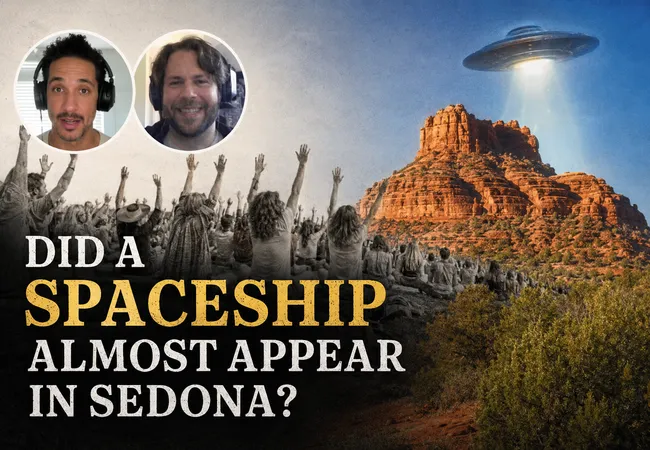
Did a Spaceship Almost Appear in Sedona?

[00:00:00] Adam: Can a hike in Sedona, Arizona, change your life?
[00:00:04] Some say there's a powerful energy flowing through Sedona's vortexes. Others say it's all in your head.
[00:00:11] Did a spaceship appear in the late '80s out in Sedona, Arizona?
[00:00:16] In 1987, thousands of people traveled to Sedona, Arizona to usher in a new age of peace. Did it work?
[00:00:25] INTRO
[00:00:25] Adam: Hello there, and welcome to a new episode of Shaka Guide: Stories We Love. I'm Adam, a producer with Shaka Guide, and today I'm joined by my fellow colleague, writer and editor, Matt Caracciolo. Hey, Matt.
[00:00:38] Matt: Hey, Adam. How's it going?
[00:00:40] Adam: It's going pretty good. You know, it's a beautiful sunny day. You can sort of see the sun peeking through the blinds here in Charlotte, North Carolina.
[00:00:47] I'm excited. It feels like the weekend's already here. It's Thursday. Might as well be the weekend. Yeah.
[00:00:52] Matt: Might as well be the weekend.
[00:00:53] Adam: Yeah. It's
[00:00:53] Matt: Who's working tomorrow? Nobody.
[00:00:54] Adam: But whatever Eh, it's weekend, weekend adjacent, So today we're, we're talking about, I think, one of our mutual favorite places. I don't mean to speak for you, but, Sedona, Arizona, the tour that you wrote and I was lucky enough to produce and test, and in particular, the vortexes in Sedona. Also, their connection to this mystical event that occurred in the late '80s called the Harmonic Convergence.
[00:01:23] So, definitely stick around to find out what that's all about. I think a good way to start this conversation is with a very simple but maybe kind of complicated question: what exactly is a vortex? Go.
[00:01:37] Matt: No, that is a good question. And yes, you're right, Sedona is one of my favorite places that I've been to for Shaka Guide, for sure. And I see you've got your necklace there that is from Sedona.
[00:01:48] Adam: Oh, this old-- this old thing?
[00:01:50] Matt: That old thing.
[00:01:52] Adam: Yeah. I don't know if this is visible or not. Probably not super clear, but basically, yes.
[00:01:57] I purchased this on my trip years ago, then I lost it. You went back, because we revamped the tour. You kindly found it out by Oak Canyon.
[00:02:06] Matt: Yeah, there's a couple designated spots with-- I think the sign just says Native American Craft Market, and yeah, I think primarily Navajo come and set up, little booths sell things, like that necklace. So yeah, I'm glad I found it, because I wasn't quite sure if that would be a successful mission or not, and it was.
[00:02:23] Adam: Success. And I love it, and I wear it often. I was also gonna mention that, etched into this hand is a spiral which sort of resembles, or at least resembles what I-- what comes to mind for me when I think of a vortex.
[00:02:36] I just think of, I don't know, some sort of,
[00:02:38] Matt: Like a swirling thing, right?
[00:02:40] Adam: Yeah, sw- energy and it could take the shape of spirals.
[00:02:44] Matt: Right. So, the most basic common definition I've seen for vortexes is that they are concentrated spots of earth's energy that course through the Earth in, yeah, a swirling vortex fashion in that spot.
[00:02:59] It's a place you might go to, find some healing, some introspection. People go to these spots to meditate, or do yoga, or other things.
[00:03:09] Adam: So is all of Sedona considered a vortex?
[00:03:12] Matt: I've seen before that all of Sedona is considered a vortex, but there are definitely specific spots that are definitely a specific vortex area. Like Bell Rock, Cathedral Rock, Airport Mesa, a few others. Those are specific places people go to, like I said, meditate or do yoga or try to feel the effects of a vortex.
[00:03:35] Adam: The effects of a vortex. I guess that begs the question, maybe I'm jumping the gun here because we've got some other things to talk about, but you've been out there twice.
[00:03:45] The people I'm sure are itching to know, did you have any personal experience with, you know, any kind of energy shift or something during your time doing research out in Sedona?
[00:03:56] Matt: So yeah, I've been there twice, and the answer is no, I didn't feel anything in particular. they say that Maybe you can feel a little tingliness or some people even feel like an overwhelming sense of calmness or like a vivid dream, or they feel some sort of kinda inner healing. And I imagine those are the sorts of things that you would feel if you lingered in a place long enough to open yourself up to that possibility.
[00:04:24] And you know how it is when we do these research trips or we go test a tour, they're pretty quick-moving. we don't have a lot of time to just kinda sit and wait for something to happen. I did go to most of the places that are considered a vortex. I stood on Airport Mesa for a little bit enjoying the sunset, and there were people there doing their thing, and there was somebody playing, "Moonshadow" by Cat Stevens, which totally fit the vibe.
[00:04:46] But I can't say that I felt anything in particular. What about you? Do you feel anything?
[00:04:51] Adam: Uh, same. And I'm glad you mentioned that about the busyness of our experiences when we're researching, writing/testing, whatever the job may be, there isn't all that much time, as amazing as it is to get to travel to some of these far-flung scenic spots across the country.
[00:05:09] I only got to do pieces of hikes. And there's this nagging feeling when you're out there or wherever that you need... That there's always something to do. Or I need to be somewhere already, or I'm behind kind of. That said, I think we all carve out some time to just, be and of course, the beauty or the magic of a place does reveal itself, not necessarily via a vortex, by just hanging out. I learn things by just meandering and kinda getting lost.
[00:05:37] And so, I didn't feel anything, but it's impossible not to be moved by incredibly gorgeous, endless red rock. Which-- it's not a landscape that I have much familiarity with coming from the East Coast. So--
[00:05:53] Matt: Same. Samesies.
[00:05:54] Adam: Yeah, I could just stare.... I mean, you can, and you could call that, I don't know, not a vortex per se, but I do feel just like a heightened sense of connection. Being out in nature, inevitably, no matter where you are, is calming. And there are some landscapes in that part of the country that are just jaw-dropping and bizarre at times.
[00:06:15] A lot of the tours we have in the Southwest are hypnotic and alien-esque, like in Zion, Capitol Reef, Monument Valley... giving a little bit of a plug for our other tours in the region and also that, even if you don't have an awakening, you're gonna be transported just by the beauty.
[00:06:31] Matt: Yeah, and I think we've said this before, but Sedona's a good place to just connect spiritually in any way that you are inclined to. Whether that's something like vortexes or, there's the Chapel of the Holy Cross. That's a Catholic chapel set among the red rocks, literally on top of a cliff actually, and then surrounded by more cliffs. There's the Amitabha Stupa and Peace Park for more Buddhist Zen atmosphere. So it's hard to go to Sedona and not feel connected in some way.
[00:07:03] Adam: Yeah, and I'm super glad you mentioned those two particular stops because they're pretty remarkable, and they're so different. If I remember, the Chapel of the Holy Cross is, built into the hillside.
[00:07:14] Matt: Yeah.
[00:07:15] Adam: Is that right?
[00:07:16] Matt: Yeah.
[00:07:16] Adam: I have it...
[00:07:17] Matt: It's set on top but it's also in-- you're right. If you look at it from below, it looks like it's just shoved into the cliff, almost like it's a book on a bookshelf.
[00:07:26] Adam: Yeah, I like that. Okay. So we've got this tour in this stunning place: Sedona, Arizona. Why is it such a popular place for vortexes?
[00:07:34] Matt: Yeah, that's a good question. First of all, the Native people that have lived there for generations, the Yavapai and the Hopi, even as far back as them, they recognized that there was something special about that area, and they even have, a tradition of power spots generally in the Sedona area where they use those spots for ceremonial purposes, that sort of thing, where they believed that those spots were home to deities. So, it goes as far back as that, the idea that there's something special about Sedona's rocks. But in terms of a more modern idea of vortexes, I think came along more in the '60s and '70s, and then, in the '80s, somebody actually made a map of where these vortexes are believed to exist in Sedona, places like Bell Rock or Cathedral Rock. And from there, I think it ballooned into Sedona being this place for new age healing-- that kind of metaphysical angle-- and it's gone from there.
[00:08:32] Adam: Interesting. Um, Sedona is, is clearly super famous, maybe one of the most famous spots to experience a vortex, but what are some others out there that you know of?
[00:08:43] Matt: Yeah, I know that Mount Shasta in California is another hotspot. I've heard that Haleakala in Hawaii is another place where people feel the Earth's energy. Stonehenge in the United Kingdom, Machu Picchu, and I'm sure countless others, but those are ones that I've seen listed before.
[00:09:03] Adam: And speaking of just other places, have you ever experienced anything akin to, I don't know, energy shifting, in another part of the world?
[00:09:13] Matt: I don't think so. Not in the way that a vortex is described, I don't think.
[00:09:17] Adam: Okay. Well, I have a little anecdote. So I live most of the year in Puerto Vallarta, Mexico, and about 90 minutes outside of PV in the mountains is a super tiny town called Yerba Buena, and they have what's called like, an energy focal point, which is just another way of saying vortex essentially. There are these four columns spaced out, and it's open air, it's just this little courtyard in the middle of this small town-- and if you're there at the right time, there is somebody that will guide you for free, and then there's a donation bucket if you wanna leave something. And you get in the center of this circle, and he says some things, some magic words, and there's something about the colors of each column that you stare, you kind of move in a circle, and you look at each column.
[00:10:05] Two things can happen. There's like a healing if you have some kind of an injury or you're working on, be it internal or external. But acoustically, there is a shift in, in the sound. And everything just... everything's a little bit heightened, and there's like an echo, which feels very bizarre because, again, how, why here? Why this spot?
[00:10:24] No one really knows how it all began. And I imagine there are many other spots like that in small towns that no one even really knows about.
[00:10:30] But I did see somebody have an experience. I didn't personally feel it, but this woman had like a lower back problem, and she kind of fainted, or he touched her, and she fell. So I mean, there's just... Who knows? I'm, I'm... Who knows?
[00:10:44] Matt: Wild.
[00:10:45] Adam: Yeah, it was very bizarre. And also, I mean, mostly because it's such a small place.
[00:10:50] Like it's not a destination, right? You just-- you pass this town on your way to get to somewhere, "cool."
[00:10:56] It was like a reminder just to stop and try to go off the beaten path a little bit, and you just never know what kind of uh, beautiful experience you might encounter, or just a strange encounter.
[00:11:09] Close encounter of the third kind, perhaps.
[00:11:12] Speaking of, that's part of a story that you write about in the Sedona Tour- this global international event in the late '80s called the Harmonic Convergence.
[00:11:21] I love the story, I wanna hear you tell us about it.
[00:11:24] Matt: Right. So the Harmonic Convergence happened in 1987. There's this guy named Jose Arguelles. He was an art historian, a professor, a New Age writer, an early proponent of Earth Day, actually. Just a little bonus fact.
[00:11:39] But anyways, he had been studying the celestial alignment that was coming up, that there was gonna be like, six planets and the sun and moon doing something particular. And, he was also studying the ancient mayan calendar, and he believed that this alignment that was coming up was going to usher in essentially the end of history and a new era of peace. So maybe you remember that there was this whole thing that in 2012 the world was gonna end because of something that the Mayan calendar said. So this was the countdown to that. So, this planetary alignment was going to a 25-year countdown to that moment.
[00:12:16] Adam: And of course, I know because I've listened to the story, and I went and did some research on my own because it is such a seemingly out of left field like, "Wait, wait, what?"
[00:12:27] But what happened? Uh, obviously, we're still here.
[00:12:29] Matt: We are still here, unless we're living in a matrix system of some sort. Who can say, right?
[00:12:35] Adam: Who, can say?
[00:12:36] Matt: Right.
[00:12:37] Adam: At this point, I will accept pretty much anything.
[00:12:40] Matt: Right.
[00:12:41] Adam: Sure.
[00:12:41] Matt: Maybe we're in a simulation, maybe we're not.
[00:12:43] Adam: I mean, I'll just... Let me just ask Claude.
[00:12:46] Matt: Hey, Claude, do we live in a simulation?
[00:12:48] Adam: Yeah. Claude's becoming sadly, somebody I talk to way too much, and I'm, I'm, I'm not very proud of that. So anyways...
[00:12:56] Matt: Yeah, so anyways, Jose Arguelles wanted to usher in this new era of peace with a worldwide coordinated event centered around meditation. So, again, this was 1987. I don't remember particularly what day, but there were around 200 locations around the world where people gathered just to meditate, play music, just to kind of get this era of peace, so-called, started. And Sedona happened to be one of the biggest gatherings of the Harmonic Convergence because it's that sort of place where it embraces that sort of New Age philosophy, and people are already going there for vortexes. So it's a natural place for a big gathering of this sort.
[00:13:40] Adam: And there was one part of his prediction that was particularly memorable, in connection to Bell Rock.
[00:13:47] Matt: Right. So for one, he didn't quite know what was going to happen to usher in this era of peace. He thought, likely aliens could show up. And so people gathered at Bell Rock specifically. If you've been to Bell Rock, I know you have-- but anyone listening if you've been to Bell Rock, you know that it looks a little bit like a spaceship.
[00:14:07] It looks like it could be the lid for a spaceship to just rise from. And, so people thought there might be a spaceship that comes out of there. It didn't yet. Uh, some other ideas Jose had were that maybe the Mayans make an appearance.
[00:14:23] He didn't know. He just thought something big was going to happen to clearly usher in this 25-year countdown to a new era.
[00:14:30] Adam: And one thing I love-- John Denver, musician John Denver, and actress Shirley MacLaine apparently participated in this event. So this was like a huge thing that attracted people from all walks of life across the universe, or across the world.
[00:14:45] Matt: Maybe the universe.
[00:14:47] Adam: Maybe the, maybe in the universe. Okay, so to recap, Mr. Jose Arguelles predicted a spaceship might emerge from Bell Rock, which it didn't, and that the world would end, which it didn't. But thousands of, hundreds of thousands, I'm not quite sure, of people gathered, in various parts of the world, and for at least a brief moment, they experienced whatever version of, like a transcendental state which, what's wrong with that, right?
[00:15:12] If they had fun and no one got hurt, so be it.
[00:15:15] Matt: Right? It's just people getting together and, playing drums and doing yoga and just generally sharing in the anticipation of something big. Nothing too wrong with that, I don't think.
[00:15:26] Adam: So yeah, all to say, Jose, his predictions didn't come true in the way, in the dramatic fashion he thought they might.
[00:15:34] So some people could just be super dismissive and be like, "Whatever." But we'll never know exactly what some people feel or could feel, even if we ourselves didn't. But do you think that vortexes are real, or is there any like, scientific evidence supporting the existence of vortexes?
[00:15:52] Matt: Yeah, I know that some people have tried to scientifically prove vortexes, and so far there's nothing too conclusive. But like geologically speaking, Sedona's kinda like unusual rock formations and the high mineral content of some of the rocks, they do create a unique electromagnetic field, I guess, and maybe that affects the body in some way. Uh, that's one theory that people have brought up as a scientific explanation for vortexes. Another thing is that it's just kind of a no-brainer to go out in nature and spend time doing things that you like, and meditate and self-reflect. Like, it's all good things, you know? Maybe one of the explanations for vortexes is that you are kind of prompted to feel something in a place as special as Sedona.
[00:16:36] Adam: Yeah. Well said. And ultimately, regardless of the research that's been done or what has been concluded or not concluded, a lot of it's gonna inevitably be a question.
[00:16:48] But, the best thing one can do is just to go find out for themselves, and that's really the only, the only way you're gonna kinda discover anything, is to try it out for yourself. So yeah, I'm sure you would agree, I recommend heading out to Sedona whenever you possibly can because, vortexes aside, it's just a incredibly beautiful place.
[00:17:12] And beyond the landscape and the nature and the hikes, there are so many interesting things surrounding or on the outskirts of the town, and you learn a lot of information when you take this tour. Particularly, one of my favorite spots was, an optional leg that we direct people to out to Jerome, this old mining town.
[00:17:33] Matt: Yeah, I can't recommend it enough. Like you said, it's just-- it's a place I think about going back to a lot.
[00:17:39] I think it'd be a great workcation, where you're just surrounded by beauty all day, you work a little bit, maybe you hike in the afternoon or early morning, take a dip in the pool, get back to work. Yeah, we're just selling Sedona for everyone.
[00:17:52] Adam: Yeah. It's like you'd think we're sponsored by the Sedona Chamber of Commerce, and in fact, we are not. I think that's a great idea, maybe we can convince our bosses to create a little work rendezvous, reunion.
[00:18:04] Matt: Love it. Love it!
[00:18:05] Adam: All right. Well, we're gonna wrap up this conversation around vortexes and the harmonic convergence in Sedona, Arizona. I've thoroughly enjoyed reading this tour and experiencing this tour for myself. Matt, I just wanna say thank you so much for your time. Thank you for joining Shaka Guide's look at vortexes.
[00:18:24] Matt: We did it again.
[00:18:26] Adam: Hooray. Hooray.
[00:18:28] All right, sir. I'm gonna press stop







 to fuel your ride
