



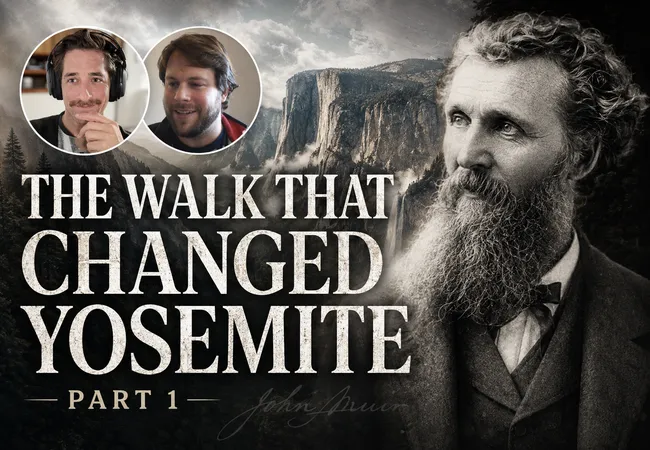
The Walk That Changed Yosemite Forever
[Transcript]
Adam: [00:00:00] Hello out there. My name is Adam, and I am a producer with Shaka Guide. And I'm here today with Matt Caracciolo, who is a writer and editor, also with Shaka Guide. And we're gonna be diving into one of our favorite stories that tracks the life and legacy of the late great John Muir.
John Muir: I only went out for a walk and finally concluded to stay out until sundown.
For going out, I found was really going in.
Adam: We are gonna discuss one of our favorite stories from our Yosemite National Park tour about John Muir and how he helped create the establishment of Yosemite National Park in Northern California. So how are you doing, Matt? What's going on?
Matt: I'm doing good. Happy Friday.
Adam: Happy Friday, [00:01:00] for sure. We made it. I feel like post-holiday madness, things are like slowly getting a little bit quieter and like finding my, my old work sea legs.
Yeah. Okay. So the story that appears in the Yosemite tour tracks the life and legacy of the late great John Muir. For those who may not be familiar with who this famous American, well, Scottish American character is, can you just kind of tell us a little bit about his origin story and who he is?
Matt: Yeah, definitely.
And like you said, John Muir was Scottish American. So he was born in Scotland in 1838, and then he moved with his family to Wisconsin at age 11. So like he had the Scottish accent for his life, his whole life, but he spent most of his time in America. And he grew up on a farm in Wisconsin. His dad was [00:02:00] a pretty strict guy.
Didn't have a great relationship with his father. And so he spent a lot of time outside farming obviously, and when he wasn't farming, he was trying to get away from his dad by also spending time outside. So you can kinda see like the, the beginnings of his, his naturalist inclinations at an early age where he's like, "You know what?
I'm just gonna get away from my dad and go spend some time out in the woods."
Adam: And so he's uprooted, finds himself in the heartland in the US, and is slowly starting to like find solace and enjoyment in just being in and observing nature. I understand he, from the tour that I, that I produced, you know, I know a little bit about him, that he was very curious- Right
and he had a lot of interests, but could you give us a little insight as to what happens as he starts to grow up?
Matt: Yeah, so you're right that he had a lot of interests. He ended up attending the [00:03:00] University of Wisconsin, but didn't really focus on one thing or another. He just kinda took courses in things that he likes, like geology and botany.
He didn't graduate and actually he just ended up getting a job after he dropped out in Indianapolis at like, kind of like a, an auto shop at the time. They didn't have autos at the time, but it was like a, like a carriage repair shop. So that, that's kinda where he landed after college. He wasn't really spending out- He didn't spend a lot of time outside like he was as a kid.
He was actually kinda leaning more towards the industrial side of his interests.
Adam: And when he was in this, this carriage repair shop, sort of a, an AutoZone of the 19th century, can you tell us about what, what happens? 'Cause I, I know there was an incident, if you will.
Matt: Yes. So there, there's a big incident at the repair shop.
So he has an accident which leaves him blind for kind of a long time, or like a startling amount of time. He had to [00:04:00] spend two weeks in a totally dark room to kind of reset his eyes. Imagine you had to spend two weeks in just total darkness, can't look at anything, can't really do anything. You know, what would be running through your mind?
Luckily he did ... About a month after the accident he got his sight back. Uh, everything was fine. But because of that he was kinda like, "The heck with, uh, industry and this, you know, autism of the 19th century. I am going to spend my time outside." That is like a major turning point in his life.
Adam: So temporarily totally blind, and then regains his sight, which is wild.
So that sort of shifts his focus, no pun intended, into reimmercing himself in the outdoors or in nature. What happens next? Where does John Muir find himself after this, this major event?
Matt: So he leaves Indianapolis. He decides he's going to [00:05:00] walk to Florida from Indianapolis, you know, as one does. But basically his idea is like, "I'm just going to go explore."
He's thinking about heading to Latin America. On the way he actually gets sick, he gets bitten by a mosquito. He's like, "You know what? I'm gonna go somewhere more temperate where there are not so many mosquito-borne illnesses." Yeah. So that redirects him to California. He sails on a boat, he arrives in San Francisco, and basically he asks someone, like, "Point me to the nearest wild place."
And so from San Francisco he walks to Yosemite Valley. Which at that time, President Lincoln had already granted, kinda like set aside as protected land, but a state park situation. It's not a national park yet, but it is kind of sort of reserved, or at least supposed to be, for protection.
Adam: Okay. So he walks
This man liked to walk, first of all. Let's just-
Matt: He did like to walk.
Adam: That [00:06:00] is very clear.
Matt: Maybe just another side effect of the bad experience in the so-called auto shop. It's like, "You know what? I don't trust carriages anymore." I don't know if that's true. He probably also took carriages, but for the sake of this story we're gonna say he just enjoyed walking for that reason
Adam: And I imagine with all this walking and no Fitbit to count those steps, I'm guessing that all that time spent being outdoors only added to...
I mean, he's like increasingly kind of obsessed or super curious, maybe obsessed is a strong word, I don't know,
Matt: with- No, I think it, it's probably the right word. Like, or enamored or something like that. He's definitely taken in by outside, by wilderness. Yeah. I don't think you used too strong a word. '
Adam: Cause I, I guess what I'm thinking is like he's already got quite a bit of knowledge, at least from the time he spent at the University of Wisconsin about botany, and even when he's walking to the Gulf, and then he ends up in San [00:07:00] Francisco walking to Yosemite Valley- that he's just collecting information all the time from notes about plants and, I don't know, whatever else he could glean from just all this time spent navigating nature.
Matt: And when he gets to Yosemite, I don't know how in love with everything he's seen he was up to that point, but he was definitely flabbergasted by Yosemite Valley. He'd definitely never seen anything like that. And so I'm thinking that as soon as he sees Yosemite Valley, that might be a particular kinda light switch.
It's like, whoa, something like this is worth protecting.
Adam: I'm glad you said that, because that's another in a series of turning points in the development of John Muir from budding nature lover to full-on naturalist, right? Whatever magic thing happened upon seeing the valley and its stunning beauty, that just [00:08:00] influenced the next kind of iteration of his life and career.
Can you kinda take us to John Muir in the late '60s, Yosemite Valley? What happens next?
Matt: So like you said, John Muir doesn't show up to Yosemite as a naturalist. Like, he likes the outdoors. He's had some classes in college, but he's not by trade or by reputation a naturalist of any sort. But when John Muir shows up to Yosemite in 1868, in- that is a total pivot of his trajectory.
He's like, "This is where I'm gonna spend a lot of time." So he ends up getting a few odd jobs in the Yosemite area. The first one is he actually is in charge of looking over 2,000 sheep up in Tuolumne Meadows. So he's a shepherd to start for, like, $30 a month. And while he's there, he notices a couple things.
One, he notices that the sheep are wrecking the meadows because [00:09:00] he calls them beast locusts, 'cause he just sees how much destruction that they are causing. And also, he's looking around at all these granite domes and wondering how they were created. So at the time, the idea was that Yosemite Valley must have been created by some sort of, like, cataclysmic event, like a earthquake or something along those lines.
But he is thinking, you know, maybe they were more shaped by glaciers. At the time, that was, like, a really odd thing to think. But he ends up being proven right years later. And after his stint as a shepherd, he just couldn't handle the sheep anymore. He ends up getting a job in Yosemite Valley in a sawmill, which is a little bit more his speed.
And while at the sawmill, he begins to write more. So he's a pretty solid writer. He is somewhat college educated, and that's how he starts becoming a naturalist, is that he starts writing, his writings get published, [00:10:00] and people start giving him attention as sort of an expert on Yosemite.
Adam: In, in this, like, next stage, right, he's getting some cred.
He's becoming sort of a go-to voice that's broadcasting what's going on in this delicate, beautiful area that sounds like it's somewhat overrun, or at least we've got these hoofed locusts running amok. And he's, I think, also shocked by some other ways in which the valley or the general area is being compromised.
Like, at this point, just as a reminder to those that may not be familiar with the story, Yosemite's not a national park, not even really close to becoming a national park. These writings are getting published. He's getting more, more and more attention. Can you help shed some light on the next phase?
Matt: So there's a couple things to keep in mind.
Number one, Yosemite Valley used to be inhabited by the Ahwahneechee tribe for many, many years, and it was only in 1851 that they were removed. [00:11:00] If you have this idea that Muir and others discovered this pristine wilderness that was completely empty, that's not what happened. People were living there, and then they were removed.
So after the Ahwahneechee tribe was removed, settlers started m- making their way in. You have homesteaders starting to do their thing. You do have people beginning to make rudimentary cabins and tourist infrastructure 'cause it's obviously gorgeous, and they know that people wanna come and see this, so they are trying to capitalize on that.
And then it's only in 1864 that Lincoln grants Yosemite Valley and a grove of redwoods called Mariposa Grove to the state of California for protection. But by then, the settlers had kind of already moved in and built fences and there's pasture. And the areas around Yosemite Valley, there's logging going on, like it's definitely a lot of human activity.
So that's kind of the landscape of Yosemite when John Muir entered.
Adam: It sounds [00:12:00] chaotic, like there's a lot of conflicting ideas about what this place should be or could be, who owns it, who doesn't. A lot of competing interests, I guess, is maybe one way to put it.
Matt: Yeah. And it's a common thread in a lot of the early national parks 'cause there wasn't, there wasn't a national park system right off the bat.
So what the idea of a national park even means meant different things to different people. So it was kind of the Wild West of conservation.
Adam: The Wild West of conservation. That's good. Trademark that. So John Muir is becoming this known entity around the importance of conserving and preserving our natural world, and particularly Yosemite Valley and its surroundings.
So he's writing and writing and writing, but if you could maybe speak to the impact of his writings.
Matt: Yeah, so yeah, he's definitely committed. He definitely wrote a lot of stuff. He wrote over 300 articles in [00:13:00] his lifetime, 12 books. So the more he writes, the more celebrities and people with political power recognize him or even seek him out for advice or information.
And he actually gets the attention of Robert Underwood Johnson, who's the editor of Century Magazine, and they actually go on a camping trip together up in Tuolumne Meadows, where John kind of convinces him to campaign to make this a bigger national park. So at this point, Yellowstone has been established.
Yellowstone was the very first national park. So John Muir is thinking, "Well, if they can protect Y- Yellowstone, they can protect Yosemite." So they get this idea to just keep featuring John Muir's writings in Century Magazine and urge readers to write to Congress, basically, and tell them, "Hey, can we save Yosemite as a national park?"
To quote John Muir referring to Congress and writing to them, he says, "We want to make their lives [00:14:00] wretched until they do what is right by the woods." And that is basically what happened. So Congress in 1890 decided to establish Yosemite National Park. But it's not the Yosemite that we know today. It's most of it, but it does not include Yosemite Valley or Mariposa Grove that I mentioned, 'cause those are still under the protection of California.
And I guess I should say the poor protection of the state of California at the time, because there, there wasn't a lot of organization or know-how about how to protect land like that. This wasn't a thing yet. They didn't even hire, like, a, a guardian until years after Lincoln said this should be protected.
You have a big national park called Yosemite, and within that national park you have the valley and Mariposa Grove protected by the state, and they're not in such a great condition.
Adam: And those are, in terms of visiting the park, those are super special places. It's like drop-dead gorgeous part of nature, right?
Matt: [00:15:00] Yeah, like those are kind of the highlights. There's other great parts of Yosemite National Park, but people go for the valley and, to a lesser extent, Mariposa Grove.
Adam: Okay, so these are two super, super, super critical, essential parts to, like, become embedded into what later is officially- The national park.
They're not there yet. So it becomes a park without those two key components in 1890.
Matt: Mm-hmm.
Adam: And so we've got these two remaining pieces that are, like, two pieces of the Yosemite puzzle that have yet to be included. And so he's increasingly determined to protect this land or make sure it's, like, federally protected.
So what, what happens next?
Matt: Well, so why don't we take a break, and if you want to learn how the story ends, you can tune in to part two.
Adam: Thanks for joining part one of Shaka Guide's look at the life of John Muir. And in part two, we'll find out about the future of Yosemite, which is all tied [00:16:00] to a wild camping trip between Muir and a pretty surprising guest.
Matt: Yeah, you know, just the President of the United States, Theodore Roosevelt. Kind of a big deal. But you don't want to miss that story, so go ahead and click on part two and see what went down. Thanks. Hope you enjoy it!







 to fuel your ride
