



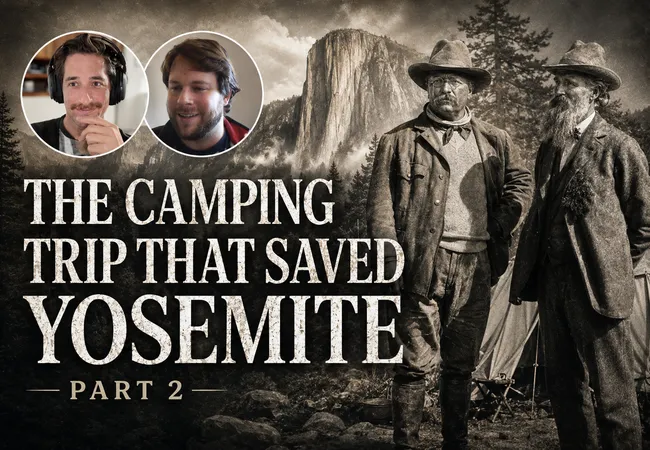
The Camping Trip That Saved Yosemite
Adam: [00:00:00] Hey friends, it's Adam again, a producer with Shaka Guide, and I'm here with Matt, who wrote Shaka Guide's Yosemite National Park tour.
Matt: Hey, everyone, welcome back. Thanks for tuning in.
Adam: So welcome to part two of our conversation about the naturalist John Muir, inspired by Shaka Guide's audio driving tour of Yosemite National Park.
In part one, we talked about Muir's early life and what led him all the way out to Yosemite Valley. And where we left off, Yosemite had become a national park thanks to John, but it didn't include some crucial parts like Yosemite Valley and Mariposa Grove. So in this video, we'll cover his campaign to save all of Yosemite, and it starts with an epic camping trip with none other than President Theodore Roosevelt.
So what happens next?
Matt: Well, in fact, the President of the United States, Theodore Roosevelt, writes to Muir asking if they can go [00:01:00] camp together. So at this point, Roosevelt's been president for a couple years. In 1903, when Roosevelt asks him, "Can we go camping?" John Muir is 65, so he's not a young guy anymore.
But Muir agrees to meet him in Yosemite to go camping.
Adam: So he's been in the valley. Is he in the valley or in Yosemite from ... He gets there in, like, the late '60s. Is he there throughout this entire time?
Matt: Uh, he leaves. He doesn't live in Yosemite. Okay. He has a family, he has a home. But he does spend a lot, a lot of time in Yosemite.
And we've been covering a lot of time during this conversation. Roosevelt arrives in Yosemite in May, 1903 with his whole entourage. Is expected to go to this big banquet with politicians and bigwigs, and he says, "You know what? Let's ditch them. Let's just get out of here." Literally with just a, a handful of rangers and Secret Service, Roosevelt and Muir just go get lost in [00:02:00] the woods three days.
The first night, they go camping on top of Glacier Point, and it snows, like, five inches, which Roosevelt w- just thought was great. He's like, "Yes, this is awesome." And the third night, they are down in the valley. And Muir kinda takes this opportunity with his captive audience to show Roosevelt some of the damage that has been happening in the Yosemite Valley.
Some of the pastures that have just taken over completely, the logging that is happening in and around the valley. And trying to get Roosevelt to sign off on adding these parts to the National Park. Federal protection will go a lot better than state protection at this point in time. And he's just urging Roosevelt to make a change.
Adam: Make that change.
Matt: Make that change.
Adam: Man in the mirror. Okay, so you [00:03:00] got two massive personalities with a lot of facial hair. Our dear friend Teddy, T.R. Roosevelt, famously bushy mustache. Mustachioed. And John Muir, who those of you who may not know what he looks like, we'll flash a picture on the screen of them together at Glacier Point, where this story takes place during Shaka Guides tour of Yosemite National Park as you're driving to Glacier Point.
So these two kind of bigger than life men are now lost in the woods. John has an opportunity to, like, really make his case for protecting this land. Roosevelt's totally into it. He's also a big advocate and lover of nature. But it is really striking that these two, particularly one being Roosevelt, a presidential figure, that they decide to do that and they just take off into the woods.
[00:04:00] Like, that's wild.
Matt: It's hard to imagine that happening today, right? Like, just- The- ... the president and some, you know, beardy guy that loves the woods just trekking out into the forest.
Adam: And regardless of what's currently happening in the political landscape, like I can't even imagine that happening in the last 50 years.
So he's got this captive audience, and Roosevelt is clearly buying in, like this land needs, needs help. How does that camp famous pivotal moment impact Roosevelt and the future of what will become Yosemite?
Matt: In 1906, he does grant Muir his wish and adds Yosemite Valley and Mariposa Grove to Yosemite National Park.
But he doesn't stop there either. Also in 1906, he signs the Antiquities Act, which allows to unilaterally establish a national monument from land that is federally owned. So they don't need any approval from Congress. If the land [00:05:00] is federally owned, he can just say, "You know what? This chunk of land is protected."
And that's still the case today. And he uses that to establish a lot of national monuments, some of which end up national parks, like Petrified Forest. He establishes more national parks. So if he was already a conservationist, he's like super conservationist after this camping trip.
Adam: And he had that shirt that said #superconservationist.
Okay. So the effort and impact of both Muir and his writings, and then Roosevelt's federal actions, it's really... I mean, impressive doesn't sound like the right, doesn't have enough oomph. The more I sit with the effort and the work that's being done to... It's like you have an idea, you make a stink about it where you like really try to like advocate and advocate.[00:06:00]
It's just really bananas and it's like a testament to the power of being so committed to something that, that you dedicate like all of your energy and life to it. Of course, these men have other things going on, families, other tasks and duties to attend to. But Roosevelt, between that camping trip, 1903, through however many years later, their legacies are available for all the world, particularly the United States, to see in the preservation of these sacred spaces.
So it's like easy to read it and be like, "Wow, that's, that's impressive," but it is millions and millions of acres of land. I mean, that's- It's a lot.
Matt: Yeah. John Muir is kind of like the poster child of conviction, right? Like, he doesn't have any special, I don't think, background skills that lent him to be a naturalist other than liking [00:07:00] outdoors and spending a lot of time outdoors.
Maybe the best that could be said about Muir's abilities is that his conviction plus his writings were just extra convincing to people. He, he did a really great job of convincing people to kind of join him in his vision. Don't we all wish that we had that power?
Adam: Yeah. Yeah. Now here's a question. Do you think Yosemite National Park would exist without John Muir?
Matt: I think so, eventually at some point. I mean, to kind of think about where the national parks were at that time, there were only a handful. There was no National Park Service yet. At that point it was just kind of a loose collection of places that people thought, "Hey, this is really pretty." And so I think eventually someone else would've said, "Hey, you know what?
Yosemite Valley is really pretty. We should save it." But then the next question is like, well, how much damage would've been done by then? Especially when you think of the Hetch Hetchy Valley, which is another part of Yosemite National Park. It's a very beautiful valley, very similar to the more [00:08:00] famous Yosemite Valley except that there's a giant reservoir in it because towards the end of John Muir's life, they actually built a dam in Hetch Hetchy which crushed him, and that was, that was one loss that he had under his belt.
He di- he did not save Hetch Hetchy the same way that he saved Yosemite Valley. And so you could think, would someone have dammed Yosemite Valley? There is a river there. Mm-hmm. That's one example
Adam: And I know this is a funny question to ask this late in the conversation, but it's kind of interesting to, to try to synthesize this man.
If, if someone's never heard of, of John Muir, like in a, in one sentence or less.
Matt: When I think of John Muir, I think of a really beardy guy with a, a kind of like a big floppy hat, um, dressed like he's gonna go hike in the woods. That's how I describe how he looks. If I would describe him as a person, I would say [00:09:00] he's just a very convicted man with a gift for writing.
Adam: He is a beardy guy. Offerman of the 19th century. That's kind of a decent comparison because they both, one worked and one does work with wood.
Matt: Mm-hmm.
Adam: During his like tinkering youth or like when he was interested in machinery and inventions, I don't know if this is actually true, this is not in the tour, but that he invented a wooden thermometer, whatever that actually means, I don't know.
But the man was like constantly making things and investigating things, be it physical things that he could create that didn't exist prior or like investigating the natural world.
Matt: Yeah. One thing people don't know about John Muir is that he's actually like a pretty handy guy. Like he's a tinkerer, like you said.
Early in life, like kinda going back to that farm in Wisconsin, he did kind of invent a few things to try to make his life a little bit easier, and one kind of funny [00:10:00] one is that he actually built like a alarm clock bed situation where his bed would like tilt and dump him out of bed when it was time to wake up, which maybe we're glad that we think of John Muir as the father of national parks and not the father of waking up in the morning.
Adam: The father of waking up. So it just like ejected you, catapulted you out of bed? Time to get up. Boing.
Matt: Yeah, it sounds like- I don't, I don't know. I don't know if it's- It sounds- ... like a slow tilt that just kinda like rolled you out of bed or, or what, but whatever it was, I'm glad we don't all have one.
Adam: Yeah.
It sounds very like Pee-wee Herman-esque in some way. Something you'd find in like Pee-wee's Playhouse. I don't know.
Matt: Mm-hmm.
Adam: Um, okay, so we've covered quite a bit about his, his super vital to help save and preserve and form Yosemite National Park, but why do people call John Muir the father? [00:11:00] of our national parks?
Matt: Yeah, it's a good question, 'cause I feel like you could almost give that name to Roosevelt too, right? 'Cause he also established quite a few. I think we give that moniker to John Muir because he was such an advocate for so many early parks. His, because he, he didn't just start Yosemite, or he didn't just help Yosemite start, he also helped, like, Sequoia and Kings Canyon, Grand Canyon, Mount Rainier, Petrified Forest, and some others that I, I can't even remember.
Like, so many. So his advocacy, his, his staunch conservationism. Like, we've already talked about how much he's written, but he also helped found the Sierra Club, which still exists, and that organization is all about conservation. He was kind of just the right person at the right time. Like, the national parks were in their infancy, he helped usher a lot of them into existence.
So it makes sense that he is kind of the guy that got the national parks rolling.
Adam: [00:12:00] Man, that was really good, Matt. You should-
Matt: I hope so ...
Adam: You should be, uh, you should write tours about the creations of national parks. I guess I'll, you know, end on the last question that I like to end most interviews. Is there anything that I didn't ask or touch on that you wished I did, or that you didn't have a chance to maybe elaborate on more?
Matt: So, okay. So you were wondering earlier, did he just spend all of his time in Yosemite? And I told you the answer is no. Like, he had a family, he had a couple daughters later in life. His daughters actually traveled to Petrified Forest with them and kind of explored. They lived outside of San Francisco. He owned a fruit farm.
He kind of took his farming know-how and inherited his wife's family orchard, and made a pretty good profit. Like, he was not some Johnny Appleseed guy that just, you know, walked around without any shoes and just lived under the trees. Like, he was actually pretty well off and a [00:13:00] successful businessman and family man.
We try to cover a little bit about that in the tour, kind of after we cover this whole Yosemite saga. Just 'cause it's helpful to r- remember that these historical figures don't just exist in the stories that we think of. They had families, they had other jobs, and that is definitely true for John Muir.
Adam: They're three-dimensional human beings. They're not just, like, in a vacuum as, like ... You know, you hear the term, like, conservationist or peacemaker. Like, they're bigger than, than just that one job title or thing that they're famous for or whatever. Like, this is really ... All right, Matt, well, I guess that's a wrap on our main man, John Muir, and his wild effort to save Yosemite National Park from being totally worn down by the hoof locusts.
And whoever else was trying to, like, get in on the game to turn a buck out in the wild, the Wild West of [00:14:00] Northern California. But I just wanna thank you all for tuning in, and I wanna say thank you to Matt for joining me today. Thanks to John Muir and old TR, AKA Teddy Roosevelt, for helping protect our sacred spaces.
The country would be worse off, to put it lightly. But if you like stories like this, please subscribe to our YouTube channel and continue to check our other social channels for excerpts from said conversations. Shaka Guide is actually celebrating its 10th year, 2026, so come celebrate with us. And you can stay tuned in by following us on social media and also downloading the app to just become more engaged with the tours that we continue to add to our existing cadre of tours.
All right, well I'll let you get back to a day in the life of a writer editor in Sequim, Washington
Matt: Actually gonna be recording a bit of Pacific Coast Highway here in a half an hour, 'cause I, I wrote a bit of it where it's a conversation between myself and Schultz. [00:15:00]
Adam: Oh, great.
Matt: So I gotta record those today.
Adam: Okay. Well now you got your, your pipes warmed up.
Matt: Blah, blah, blah, blah, blah.
Adam: Until next time.
Matt: Thanks Adam. This was fun.
Adam: All right my friend, signing off. As always, let's explore together!







 to fuel your ride
