



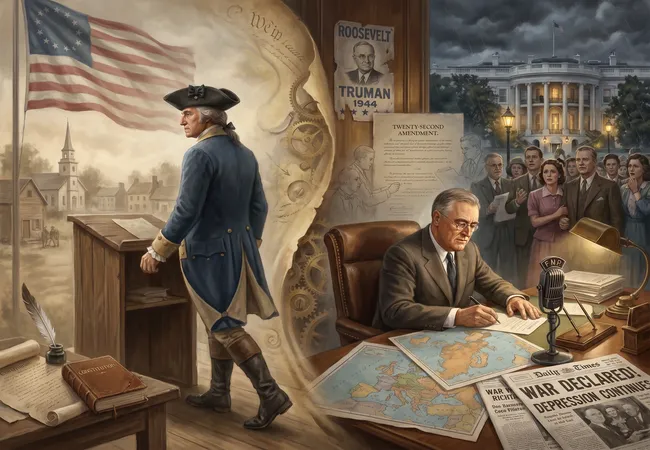
FDR & the 22nd Amendment: Tidal Basin Washington DC Story

Table of Contents:
[Transcript]
The President Who Broke a 150-Year Tradition
Now, when you hear FDR, what comes to mind? The Great Depression, the New Deal, World War II. Well, one of FDR's biggest flexes, as the kids say, is that he's the only president in history to serve four terms in office. And he's also the reason the Constitution now limits presidential terms.
Why Washington Walked Away
Let's go back to the very beginning of American democracy, George Washington's presidency. Washington was elected unanimously and led the country through its fragile first years. And then he walked away from the position.
He could have stayed. I mean, many people wanted him to, but he believed that no democracy should depend too heavily on one individual for that long, no matter how capable that person was. Two terms was never a law.
But for nearly 150 years, every president followed Washington's example, until FDR took office in 1933.
Crisis, War, and Four Terms
The country was in crisis. Banks were collapsing.
One in four Americans was unemployed. Faith in government was fragile. Over the next eight years, FDR created jobs, reformed financial systems, and established Social Security.
And just when the nation had begun to recover, the world moved to war. At that point, FDR was at the end of his second term in office. But in moments of uncertainty, people often cling to stability, right? And by 1940, many Americans believed that changing presidents in dangerous times felt riskier than keeping the one they had trusted.
So Roosevelt ran for a third term, and he won. Then in 1944, with World War II still raging, he ran again, and he won again. Four terms.
That was an unprecedented extension of presidential power.
The Amendment Born from His Absence
But just two short months into his fourth term, FDR died, and the country faced a sudden transfer of power in the middle of a global war. Vice President Harry Truman stepped into the presidency, and suddenly, many Americans realized they didn't know anything about his leadership style.
They had relied too heavily on FDR's presence, and they didn't think about what would happen in his absence. And that was risky. In a democracy, the country must be the priority.
It's more important than the effectiveness or popularity of one individual. So just two years later, in 1947, Congress proposed the 22nd Amendment. It was ratified in 1951, and it formally limited presidents to two elected terms.
Not because FDR had been a tyrant, not because Americans regretted his leadership, but because democracy depends on renewal, rotation, and on the peaceful, predictable transfer of power.










 to fuel your ride
